


Geoff Nunberg
Geoff Nunberg is the linguist contributor on NPR's Fresh Air with Terry Gross.
He teaches at the School of Information at the University of California at Berkeley and is the author of The Way We Talk Now, Going Nucular, Talking Right and The Years of Talking Dangerously. His most recent book is Ascent of the A-Word. His website is www.geoffreynunberg.com.
-
 Foreign nations have been systematically spreading falsehoods on social media for years; in 2019, it seemed like the world began to fully grasp the ramifications of disinformation campaigns.
 -
 A lively new book by Gretchen McCulloch dissects the common vernacular that forms the cornerstone of online communication. Because Internet parses emojis, lols and punctuation — or lack thereof.
 -
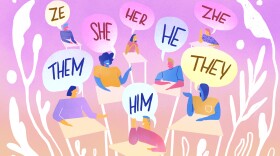 For anyone struggling to use "they" as a singular pronoun, linguist Geoff Nunberg says: Just practice. He believes human language processing capacity is far more adaptable than people realize.
 -
 Artificial intelligence becomes hard to ignore when it starts taking over tasks that used to require human judgment — such as winnowing job applications or prioritizing stories in a news feed.
 -
 It isn't yet clear where "socialist" will settle in the vocabulary of the American left, as it jostles with labels like "liberal" and "progressive." But it's not the S-word anymore.
 -
Seven-year-old Jakelin Caal died in U.S. custody in December. Linguist Geoff Nunberg says her death might have been prevented had border agents spoken the Mayan language Q'eqchi'.
-
 President Trump created a firestorm when he described himself as a "proud" nationalist at a recent rally. Linguist Geoff Nunberg says the word carries a specter of racism and belligerence.
 -
 Geoff Nunberg says that "falsehood" isn't just a decorous synonym for "lie." Instead, it has a moral weight of its own — especially when it comes to the effects of what someone says.
 -
 Linguist Geoff Nunberg says it's common for citizens of democracies to express concerns about the government. But the term "deep state" refers to something more nefarious — and conspiratorial.
 -
Linguist Geoff Nunberg says none of the differences between American and British English would be interesting if the nations didn't share a core vocabulary grown from a common literary tradition.


